Playa de Punta Prima | The Beach That Starts the Day on Easy Mode
My introduction to Punta Prima did not begin with the beach at all.
Nor did it begin with the sea. It began with a question:
“Where are all these people going?”
It was around eight in the morning. The sun had already confidently claimed the day as its own, the sea looked as though someone had just polished it to a shine, and along the shoreline there was a constant stream of people moving in both directions.
Some were running.
Some were walking their dogs.
Some were simply strolling along with their hands clasped behind their backs, wearing the expression of someone who had finally discovered life’s greatest secret and was no longer in any hurry.
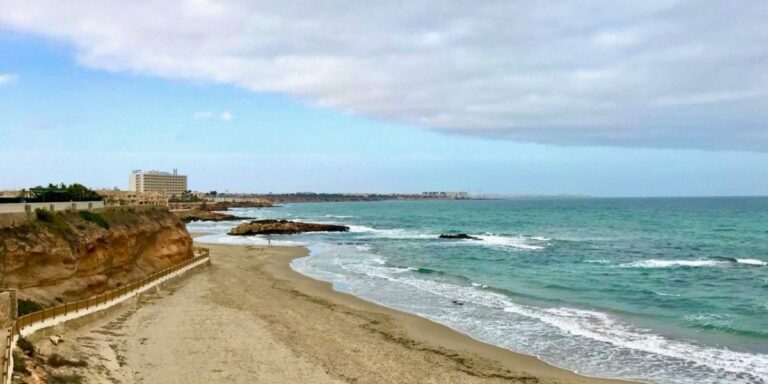
That is how I found myself on the famous Punta Prima promenade.
Looking at a map, it appears to be little more than a walkway along the coast. In reality, it is one of the finest coastal walks in Orihuela Costa. It begins at Cala Piteras and stretches all the way to Punta Prima Beach, winding between rocky outcrops, viewpoints, and restaurants overlooking the sea.
It is here that you realise something important.
Not every beach needs to be perfect.
Sometimes the journey to the beach is the perfect part.
Because Cala Piteras, where the walk begins, is not, if we are being honest, the sort of beach people book flights to Spain for.
A rocky shoreline.
Stones.
Small bathing areas.
More a place for contemplating the sea than for building sandcastles.
The same can be said for the neighbouring Playa Rocío del Mar.
Locals love these places.
Fishermen love these places.
People who enjoy sitting on rocks and staring at the horizon love these places too.
But the most unexpected surprise lies just a little further along.
Because not every resort can boast an official dog beach.
Yes, really.
Playa Canina del Rocío genuinely exists.
While owners of expensive yachts discuss fuel prices at the marina, dozens of dogs race happily along the shore, paying absolutely no attention to social differences.
Labradors.
Spaniels.
Terriers.
And one completely unhinged dachshund that, judging by the look on its face, firmly believes it is a dolphin.
It is one of those moments when you realise that Spain knows how to take life a little less seriously.
And perhaps that is exactly why people keep coming back.
Along the way, another local landmark appears – the Nautilus restaurant.
To be completely honest, some visitors come here less for the food and more for the location.
That said, the cuisine is excellent, particularly the seafood.
The building literally hangs over the sea.
During a mild storm, waves crash directly beneath the terrace, and lunch suddenly begins to feel like a scene from a film about millionaires who have escaped reality.
On a pleasant day, you want to stay longer.
On a windy day, you want to stay even longer.
A little further on stands Restaurante Punta Prima.
Less dramatic.
More traditional.
But with that unmistakable atmosphere of an old seaside restaurant where people have been returning for years and where the waiters already recognise half of the customers by sight.
And then the beach itself finally appears.
Punta Prima Beach | Small and Compact
Without trying to impress anyone with its size.
That is exactly what makes it so appealing.
There is no sense of an endless stretch of sand that requires a ten-minute walk before you even reach the water.
Everything is close by.
The sea is close by.
The restaurants are close by.
The promenade is close by.
Life is close by.
During the peak season, the beach becomes fairly lively.
Yet somehow it never loses its character.
It remains a neighbourhood beach rather than becoming a faceless tourist attraction.
In the end, Punta Prima turns out not to be merely a beach.
Or rather, not only a beach.
It is a walk.
It is the sea.
It is restaurants hanging over the water.
It is people who are in no hurry.
It is dogs who seem happier than most office workers in Europe.
And it is a very good introduction to the beaches of Orihuela Costa.
Cala Mosca and Cala Las Estacas | The Last Wild Corner of Orihuela Costa
There is an interesting pattern.
The longer you live in Orihuela Costa or spend your holidays here, the less interested you become in the most famous beaches.
At first, everyone goes to La Zenia.
Then to Campoamor.
And after that, they start asking the locals:
“Where do you go?”
And quite often they hear exactly the same answer.
Cala Mosca.
And its neighbour, Cala Las Estacas.
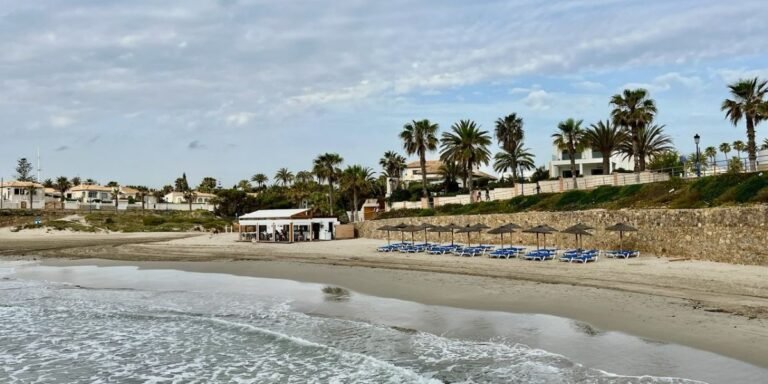
In photographs, they look like ordinary little coves.
In reality, they are far more interesting.
Because this is perhaps the last stretch of coastline in Orihuela Costa that still reminds you what this place looked like before the arrival of urbanisations, shopping centres, and endless rows of apartment blocks.
There is no long promenade here.
No vast beach areas.
No feeling of a resort production line.
Instead, there are cliffs.
The sea.
The wind.
And nature, which still occasionally insists on doing things its own way.
Especially in winter.
The locals have long known one curious fact.
Every winter, the sea comes back to reclaim what belongs to it.
Storms regularly erode both coves.
Sometimes significantly.
Sometimes very significantly.
In spring, the local authorities bring in fresh sand again, restore the access paths, and prepare everything for the start of the season.
And every year, the same story repeats itself.
The sea destroys.
People rebuild.
The sea destroys again.
It resembles certain human relationships, if you stop and think about it.
Perhaps that is exactly why Cala Mosca feels so authentic.
It never appears perfectly polished.
And that is part of its special charm.
There are many things here that cannot be planned.
The scent, for example.
If you arrive here early on a summer morning and climb onto the cliffs between the two coves, the air suddenly changes.
The salty sea breeze mixes with the aroma of rosemary warmed by the sun.
Not perfumed.
Not decorative.
Real.
The very same rosemary that grows naturally among the rocks.
Sometimes the wind carries its fragrance so clearly that it feels as though somebody has deliberately switched on a “Mediterranean” air freshener.
But no.
It is simply the landscape reminding you that it existed long before tourist brochures were ever printed.
Between Cala Mosca and Cala Las Estacas there is a small viewpoint.
And this is where one of the strangest morning rituals in Orihuela Costa takes place.
At around eight o’clock, people start arriving carrying yoga mats.
Then more arrive.
Then even more.
Before long, the viewpoint transforms into an open-air yoga studio overlooking the sea.
Some people stretch.
Some practise breathing exercises.
Some perform movements so complex that you begin to suspect the existence of additional joints.
And a little later, aerobics groups appear.
With music.
With the sound of the waves.
And under the bewildered gaze of tourists who simply came for a walk and unexpectedly found themselves at a free fitness festival.
The funniest part is that it all looks completely natural.
As though this is exactly how things are supposed to be.
Afterwards, people gradually make their way down to the sea.
And that is where an entirely different life begins.
During the summer, small chiringuitos operate directly on the beaches.
These become the centre of local civilisation.
Some people come for a cold drink.
Some come for ice cream.
Some come for ice cream for the children and a drink for themselves.
The last category is usually the largest.
To be honest, ice cream sometimes plays a very important diplomatic role here.
Because if a child receives an ice cream at exactly the right moment, the holiday continues peacefully for at least another forty minutes.
That is practically a scientific fact.
And then comes the matter of parking.
And this is where Cala Mosca unexpectedly turns into an extreme sport.
Because there are far more people wanting to arrive than there are available parking spaces.
Every summer, exactly the same scene unfolds.
Cars slowly circle the area.
Drivers pretend to remain calm.
Passengers begin offering advice.
Nobody asked for it.
Yet the advice appears anyway.
Eventually, a space is found.
Everyone is happy.
Everyone forgets about the problem.
Until the next day.
And do you know what is most surprising?
Despite the storms.
Despite the battle for parking.
Despite the fact that these beaches are neither the largest nor the most famous in the region.
People return here again and again.
Because Cala Mosca and Cala Las Estacas offer something that is becoming increasingly rare along the Mediterranean coast.
The feeling that nature is still winning on points against developers.
And when you sit on the rocks between the two coves in the evening, watching the sun slowly sink towards the horizon, it becomes perfectly clear why local residents are so protective of these places.
They know a secret.
These beaches do not try to please everyone.
And that is precisely why they appeal to so many people.
Cala Cerrada | The Beach That Pretends to Be Ordinary and Then Pulls Out a Surfboard
I ended up at Cala Cerrada completely by accident.
Just like most of the good things in life.
The plan was simple enough.
Take a walk along the coastline of La Zenia, look at the sea, and take a few photographs.
But Cala Cerrada had other ideas.
When a Beach Looks Better Than It Has Any Right To
My first impression was a strange one.
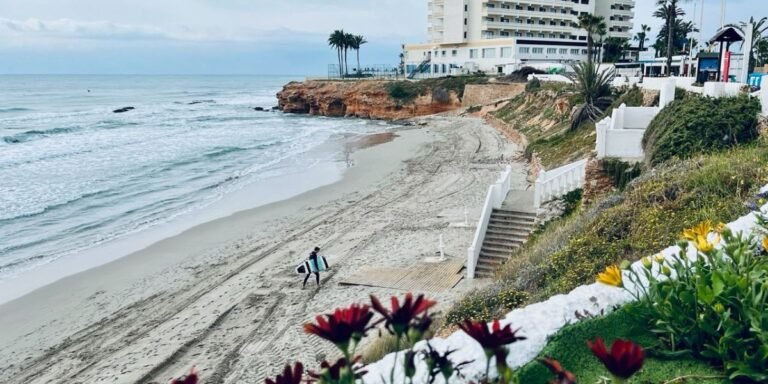
You stand at the top beside the white railing.
In front of you are flowers, palm trees, caramel-coloured cliffs, and the Mediterranean Sea behaving as though it has just been professionally colour-graded by a Hollywood studio.
You look down and realise that the cove appears far too cinematic to be an ordinary beach.
Especially if you visit outside July, when half of Europe seems to have simultaneously decided to go swimming.
The cliffs embrace the shoreline from both sides.
The sea rolls gently over the rocks.
And from above, the entire scene looks as though someone spent a great deal of time illustrating the perfect postcard for a travel agency.
It was right here that I caught myself standing completely still for five minutes, doing absolutely nothing.
For a modern person, that is practically a spiritual exercise.
The Most Unexpected Surf Spot in Orihuela Costa
Then something happened that I never expected to see in Orihuela Costa.
A man walked across the beach carrying a surfboard.
Then another appeared.
Then a third.
At that point, my brain started asking questions.
Hold on.
Are we definitely on the Costa Blanca?
People normally come here for calm waters, children with inflatable unicorns, and endless debates about where to find the best calamari.
Where exactly did all these surfers come from?
As it turns out, Cala Cerrada has a little secret.
When the wind and the sea decide to cooperate, this is where the best waves on the entire Orihuela Costa coastline appear.
Good enough, in fact, that a surf school operates here during the summer months.
The funniest part is that most tourists have absolutely no idea.
They come for a traditional beach holiday.
Meanwhile, locals who have lived here for years keep a very close eye on the surf forecast.
Every resort has its secrets.
For Cala Cerrada, that secret is surfing.
Why People Keep Coming Back
Perhaps it is the atmosphere.
Perhaps it is the fact that this place still feels like a genuine stretch of Mediterranean coastline.
Without unnecessary gloss.
Without forced perfection.
Just a gentle scent of salt, sun-warmed rocks, and sea breeze.
It is a wonderful place to sit above the cove and watch the waves.
It is a wonderful place to walk down to the water.
And it is a wonderful place to discover that Orihuela Costa is still capable of surprising even those who have been visiting for ten consecutive years.
That is precisely why Cala Cerrada remains one of the most underrated beaches on the coast.
Most tourists drive straight past.
Then they see photographs later and ask:
“Where is that?”
And they receive the same answer that locals usually give with a slight smile:
“Cala Cerrada.
But let’s not make too much noise about it.”
La Zenia Beach (Cala Bosque) | The Beach That Is Probably the Reason Ryanair Still Exists
There is a theory that nobody has ever officially confirmed.
But after several visits to La Zenia Beach, it begins to sound remarkably plausible.
If this beach did not exist, half of the flights from the United Kingdom and Ireland to Alicante would probably lose their purpose.
I realised this the moment I tried to find a free patch of sand.
It was early July.
Ten o’clock in the morning.
The sun was only just warming up.
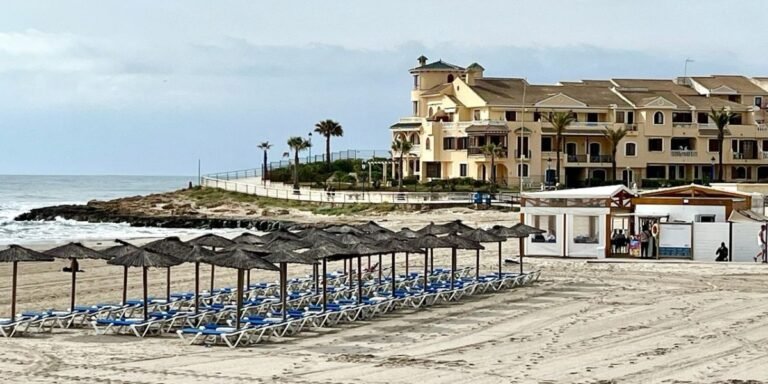
And La Zenia Beach already looked as though the whole of Northern Europe had received a personal invitation to be there.
The funniest part was that nobody seemed unhappy about it.
Normally, crowds are irritating.
Queues are irritating.
Looking for a parking space is irritating.
And the person who plants their beach umbrella twenty centimetres away from your towel is particularly irritating.
But Cala Bosque somehow persuades people to accept all of that.
Because the sea here plays unfairly.
It is simply too beautiful.
So beautiful, in fact, that fully grown adults begin behaving like children who have just seen the ocean for the very first time.
At first they say:
“Well, yes. The sea is the sea.”
Five minutes later, they are standing knee-deep in the water, photographing the horizon as though they have just been hired by National Geographic.
The Beach That Ruined My Statistics
Before I discovered Cala Bosque, I was convinced that I understood tourists.
It turned out that I did not.
Because this beach has a strange ability.
You arrive intending to stay for an hour.
Then you check the time.
And somehow four hours have passed.
Where did the time go?
Nobody knows.
Perhaps it is stolen by the children building sand fortresses the size of a small principality.
Perhaps the long walks along the shoreline are to blame.
Or perhaps it is because Cala Bosque constantly provides small scenes worth observing.
People-watching here is exceptionally entertaining.
A British holidaymaker is heroically attempting to apply sun cream to the middle of his own back.
A Spanish family is preparing a lunch large enough to feed a small army.
A German visitor has spent twenty minutes adjusting the position of a sun lounger with the precision of a NASA engineer.
And somewhere nearby, somebody is trying paddleboarding for the very first time and suddenly discovers that the Mediterranean Sea has no intention of cooperating.
The Strangest Christmas Tradition on the Costa Blanca
But I truly fell in love with La Zenia Beach in winter.
Because this is where one of the most absurd and simultaneously wonderful events on the entire coast takes place every year.
25 December.
Christmas Day.
Normal people are finishing their turkey.
Watching films.
Arguing about politics.
But in La Zenia, hundreds of people put on Santa Claus costumes and run into the sea.
Yes.
Actual Santas.
With beards.
Red hats.
And occasionally even convincing stomachs.
They laugh.
They pose for photographs.
And they organise a mass Christmas swim.
Afterwards, thousands of people gather on the beach for winter barbecues in the open air.
The first time I saw it, I assumed I had somehow suffered mild sunstroke several months earlier and was only now experiencing the consequences.
But no.
It is a genuine tradition.
And that is precisely the moment when you begin to understand the character of La Zenia.
It never takes life too seriously.
The Beach That Is Dangerous for Your Future
There is one problem.
Travel websites rarely mention it.
Cala Bosque is dangerous.
Not for your health.
For your plans.
Because this is exactly where many people have their first thought that sounds something like this:
“What if I came here for more than just two weeks a year?”
Cala Capitán | The Beach Where the Fish Worked Out How Children Operate Long Ago
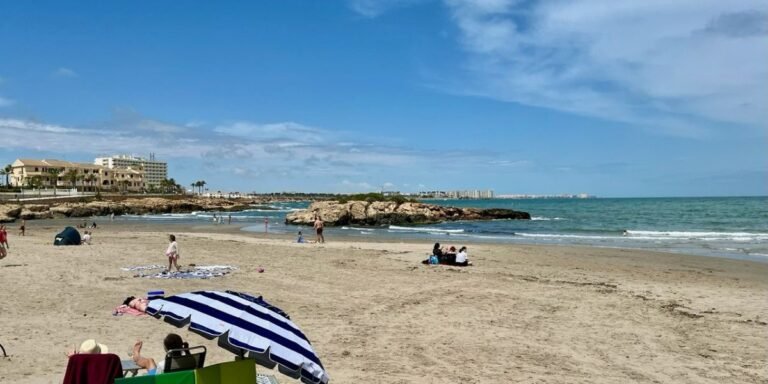
There are places that simply cannot be understood through photographs.
Cala Capitán is one of them.
In pictures, everything looks perfectly ordinary.
A pleasant little cove.
Sand.
Sea.
Cliffs on either side.
Beautiful, certainly, but not necessarily the sort of place that would persuade you to drive across the entire area just to see it.
That is precisely why the first impression is deceptive.
Because the real life of Cala Capitán does not begin on the shore.
It begins in the water.
One morning, I noticed a rather unusual scene.
Several children were standing knee-deep in the sea, staring at their feet with the sort of excitement usually reserved for discovering a sunken pirate ship.
I walked a little closer.
And then I saw them.
Fish.
Lots of fish.
They were circling around the children in a dense silver cloud.
The parents stood nearby smiling with the expression of people who had already watched this performance a hundred times before.
Later, somebody explained the local tradition to me.
Every day, someone inevitably brings a little bread.
A few children throw crumbs into the water.
Within a minute, the first fish appears.
Then a few more.
And before long, the entire cove begins to resemble a free version of an aquarium.
The funniest part comes next.
The following day, the children return.
And they genuinely believe that the fish remember them.
“Look! They came back again!”
Of course they did.
If someone offered me lunch every day, I would probably learn to recognise their silhouette from a considerable distance as well.
But children prefer a different explanation.
And if I am honest, so do I.
Because there are far too few things in this world that improve when subjected to excessive rationality.
The Friendliest Cove on the Coast
In general, Cala Capitán possesses a remarkable quality.
It somehow encourages people to behave a little more kindly.
I do not know how it works.
Perhaps it is the shape of the cove.
Perhaps it is the rocky formation that divides the sea into two distinct areas.
And that is where the magic begins.
On one side, you have the traditional beach rhythm:
Water.
Sunshine.
Swimming.
Conversations.
Children.
Sand appearing in places where sand should never logically appear.
On the other side lies a completely different world.
A section where the water is so shallow that it feels almost like a private VIP lounge for toddlers.
In some places, the depth reaches only thirty centimetres.
For children under the age of three, it is almost the perfect aquatic environment:
Safe.
Shallow.
Fun.
And free from the constant fear that their parents will suddenly have to chase them across the entire Mediterranean Sea.
The little ones are happy.
The parents are relaxed.
And only the sand continues to win the battle, as it always does, because later it will inevitably be found inside bags, towels, shoes, cars, and perhaps even in another dimension entirely.
La Caleta | The Place Where the Mediterranean Starts Flirting Quite Openly
There are beaches that should be visited in the morning.
There are beaches that reveal their best side in the middle of the day.
And then there is La Caleta.
If you arrive here on the right evening, you begin to suspect that someone up above has slightly adjusted the settings of reality.
I ended up here shortly before sunset.
Entirely by accident.
As is usually the case with the best places.
In truth, I had simply planned to walk along the Cabo Roig promenade.
A perfectly standard plan for someone who does not yet realise that their plans are about to be completely ignored.
Because Cabo Roig has a habit of disrupting schedules.
The Beach Hidden Beneath the Cliffs of Millionaires
The first thing you notice from above is not the sea.
Nor is it the beach.
It is the houses.
The kind of houses with views that some people would willingly work an extra ten years to afford.
You stand on the path above the cliffs and realise that this is one of the most expensive stretches of coastline in the whole of Orihuela Costa.
Then your gaze shifts downwards.
And there it is.
La Caleta.
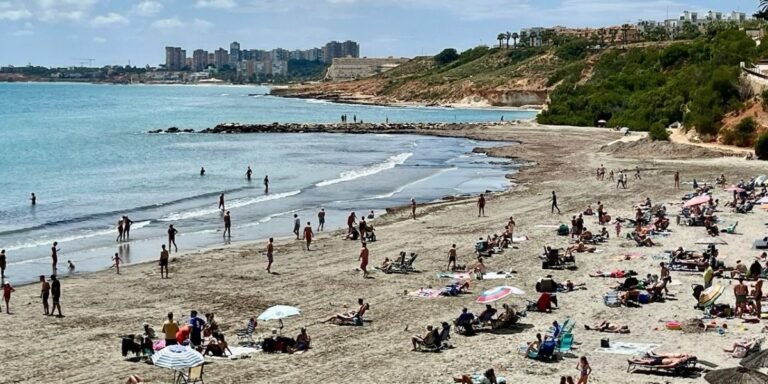
A small cove hidden between the cliffs.
So carefully hidden that it is possible to miss it entirely from above.
As though the sea deliberately kept a small private corner for itself.
The Most Beautiful Place for Doing Absolutely Nothing
La Caleta has one problem.
It is completely incompatible with productivity.
Seriously.
It is impossible to hurry here.
Impossible to walk past quickly.
Impossible to tell yourself:
“I will stay for five minutes and then move on.”
Because after five minutes, the next stage begins.
You sit down on one of the benches overlooking the sea.
Then you notice the yachts.
Then you start watching the waves.
Then you discover that forty minutes have passed.
And your only achievement during that entire time has been observing the horizon with exceptional dedication.
Which, if we are being honest, is a skill in its own right.
Why the Locals Are Protective of Cabo Roig
There is an amusing pattern.
The longer someone lives in Orihuela Costa, the more carefully they talk about La Caleta.
Not because it is a secret.
It stopped being a secret many years ago.
The reason is something else.
When you discover a genuinely beautiful corner of coastline, a strange sense of ownership appears.
As though the sea belongs personally to you.
As though those cliffs were placed there specifically for your walks.
As though that cove was created solely so that one evening you could sit on a rock and realise that you are not late for anything.
Of course, it is complete nonsense.
The sea belongs to nobody.
But try explaining that to someone who has been living in Cabo Roig for ten years.
And that, perhaps, is the greatest compliment La Caleta can receive.
It does not merely impress people.
It quietly convinces them that they belong there.
Even if only for an evening.
Playa de La Glea | The Beach Where Spain Comes to Visit Itself
There are places along the Orihuela Costa coastline where British holidaymakers spend their summers.
There are places where you hear more Ukrainian than Spanish.
There are beaches where half the people arrived from Belgium years ago and now consider themselves locals.
And then there is Playa de La Glea.
And here you suddenly realise one thing.
You are in Spain.
The National Park of the Spanish Family
The first time I came here was at around eleven in the morning.
And I made a mistake.
I thought the beach was already busy.
How naïve.
A Spanish family at eleven in the morning is only just beginning its warm-up.
The main event starts later.
First comes the grandfather.
Then the grandmother.
Then the parents.
Then the children.
Then more children.
Then someone whose exact family connection can no longer be determined without a genealogical investigation.
Within twenty minutes, a fully functioning infrastructure appears on the sand.
Parasols.
Chairs.
Cool boxes.
Toys.
Bags.
Towels.
Tables.
You begin to suspect that the family has not come to the beach at all.
The family has moved here permanently.
And do you know what?
They do it brilliantly.
The Spanish Are Better at Relaxing Than Anyone Else. It Is Annoying.
The most remarkable part begins after lunch.
Tourists usually relax according to a schedule.
Go for a swim.
Lie in the sun.
Go home.
The Spanish approach the subject differently.
They spend an entire day on the beach as though time has ceased to exist altogether.
Nobody is rushing anywhere.
Nobody checks their phone every five minutes.
Nobody is trying to achieve a target level of relaxation.
They simply live.
Right here.
On the sand.
And it is slightly irritating.
Because suddenly you realise that perhaps this is exactly how life is supposed to work.
Open-Air Theatre
If you sit near the water and simply watch what is happening around you, within ten minutes you forget about the sea entirely.
The best television series of the summer begins unfolding before your eyes.
Grandfathers are arguing about something of enormous importance.
Teenagers are pretending to be bored, despite clearly having the time of their lives.
Children are constructing engineering projects from sand that surpass certain government infrastructure programmes in both scale and ambition.
There is always someone who seems to know half the beach and says hello every three minutes.
Once, I tried counting how many acquaintances a local resident met during a single walk along the shore.
I lost track after twenty.
Why Spaniards Keep Coming Back
This is the real secret of La Glea Beach.
It does not try to impress anyone.
There is no feeling that this is a resort designed specifically for tourists.
Quite the opposite.
You get the impression that tourists have accidentally wandered into a genuine Spanish summer tradition.
That is exactly why the atmosphere feels so alive.
Slightly noisy.
Very family-oriented.
Completely sincere.
The Best Lesson Spain Can Teach You
As the sun begins to move towards the horizon, families gradually start packing their things.
Sand is shaken from towels.
Children reluctantly leave the water.
Some people are already discussing tomorrow.
Others are arranging to meet here again.
And at that moment, it becomes perfectly clear why Spaniards themselves love Playa de La Glea.
Not because of the sand.
Not because of the sea.
Not because of the facilities.
But because this place preserves something that is becoming increasingly rare in the modern world.
The ability to spend time together.
Without rushing.
Without a reason.
Simply because today happens to be a good day.
And the sea is not going anywhere.
Playa de Aguamarina | The Beach Where Parents Finally Understand Why They Had Children
First Impressions: I Came to Look at the Sea and Ended Up in the Department of Childhood Happiness
There are strange places in this world.
A casino at three o’clock in the morning.
IKEA on a Saturday afternoon.
Or a beach where a child suddenly stops asking for a mobile phone.
Playa de Aguamarina in Campoamor belongs firmly in the last category.
I arrived here in the usual mood of an adult.
Slightly tired.
Slightly hungry.
And entirely convinced that nothing could surprise me anymore.
Ten minutes later, I was watching an eight-year-old boy hurtling down an inflatable slide straight into the sea while shouting at the top of his lungs.
He was shouting as though he had just been launched into space.
And he looked completely happy.
A minute later, his father climbed up after him.
Because parents are people who first say:
“No, that’s for children.”
And then remove their sunglasses and run there before anyone else.
The Most Dangerous Thing on This Beach Is the Desire to Be Ten Years Old Again
Adults have a curious habit.
We constantly lecture children about safety.
Do not run.
Do not jump.
Do not climb that.
And then we see a parasail soaring above the sea.
A huge parachute suspended behind a speedboat, carrying someone high above the Mediterranean at the speed of a particularly enthusiastic seagull.
And immediately forget everything we were saying five minutes earlier.
You walk along the shoreline, look up, and see somebody floating dozens of metres above the Mediterranean Sea.
At that moment, your brain asks a perfectly logical question:
“What exactly is that person doing up there?”
And the answer is always the same:
“Having an absolutely brilliant time.”
At Aguamarina Beach in Campoamor, this happens constantly.
Because the entire beach feels like a conspiracy against seriousness.
Someone is paddleboarding.
Further along, a group of British holidaymakers are attempting to remain upright on a pedal boat.
Further still, people are climbing onto an inflatable banana boat.
The Beach That Cannot Be Completely Filled
You do not immediately appreciate the size of Playa de Aguamarina.
At first you think:
“Nice beach.”
Then you keep walking.
Then you walk a little further.
And eventually you begin to suspect that you have accidentally left the municipality and entered the next province.
In August, this becomes particularly obvious.
You see hundreds of people.
Lots of children.
Lots of families.
Lots of movement.
Yet somehow the beach continues to feel spacious.
This is a rare form of Spanish magic.
On most popular beaches, by midday it feels as though the entire European Union had exactly the same idea for the weekend.
Here, that never quite happens.
People spread themselves across the sand so naturally that it almost seems as though someone above is overseeing exceptionally competent urban planning.
The Chiringuito: The Place Where People Suddenly Stop Rushing
Sooner or later, every journey across Aguamarina Beach leads to the chiringuito.
Not because it has to.
Because it is impossible to walk past.
Music drifts through the air.
Laughter follows.
Someone is discussing football.
Someone is arguing about the weather.
Someone is telling friends a story that is clearly becoming better with every retelling.
Spain possesses a remarkable ability to transform an ordinary beach bar into the centre of a miniature universe.
At neighbouring tables sit people from different countries.
Nobody is in a hurry.
And it feels so unusual to the modern mind that it is slightly unsettling at first.
Playa de Aguamarina does not try to appear special.
It does not need to.
It simply does what every great beach should do.
It gives adults an excuse to feel like children again.
And it gives children memories that will continue resurfacing many years later.
And honestly, that is worth far more than any tourist ranking.
Mil Palmeras Beach | I Thought I Was Going to a Beach. It Turned Out to Be a Gathering of Humanity
Mil Palmeras Beach looks you straight in the eye and says:
“If several thousand people have voluntarily travelled to exactly the same place under the blazing Spanish sun, they probably know something.”
And, to be fair, they know quite a lot.
The Biggest Beach Is Not About Size. It Is About Freedom of Choice
Everything at Mil Palmeras Beach is wonderfully simple.
The beach is so large that the main problem of popular resorts simply disappears.
You never get the feeling that you have accidentally been invited to a family gathering hosted by people you have never met before.
There is enough space for everyone.
In one area, children organise sand-building competitions involving structures that begin to resemble national infrastructure projects.
A little further along, teenagers are playing beach football with such commitment that you start suspecting that scouts from Real Madrid are secretly observing the match from nearby bushes.
And further still, an entirely different atmosphere takes over.
People are so relaxed that it feels as though somebody has finally given them official permission not to reply to a single message.
And all of this exists simultaneously.
On one beach.
Without conflict.
Which already feels slightly suspicious.
The Chiringuito: The Place Where Time Disappears
There is another trap at Mil Palmeras Beach.
A very dangerous one.
It is called a chiringuito.
A beach bar.
It sounds harmless enough.
But this is exactly where strange things begin to happen.
You walk in intending to stay for only a few minutes.
Just enough time for a cold, light lager served in a frosted glass.
And then, somehow, you discover that the sun has noticeably changed position in the sky.
At the neighbouring table, somebody is discussing football.
Nearby, a large group of friends are laughing.
Someone else is telling a story with so many gestures that it appears a theatrical performance may begin at any moment.
Eventually, you realise something important.
The secret of Spain is not really the climate.
The secret is its ability to turn an ordinary day into an event.
Simply because that is how the Spanish are.
A Place You Only Understand Just Before Leaving
Mil Palmeras Beach creates a rather unusual effect.
While you are there, it feels as though nothing particularly special is happening.
It is simply a very good beach.
And then, suddenly, you understand why Mil Palmeras remains a favourite destination for so many families.
Because this beach reminds you of one simple truth.
Sometimes the best day of your holiday looks nothing like the one you planned.
And that is exactly why you remember it for such a long time.